
There once was a time when you had to look in a dictionary for the definition of a word, you had to come up with your own ideas for projects and you had to draw your own art. Now thanks to the rise of artificial intelligence (AI), it’s much faster and easier to find definitions, generate photos and videos, come up with ideas for your projects, and so much more. But how did AI come to be?
Dating back to the early 1900s, people such as Alan Turing thought that there should be an easier and faster way to solve problems and do things that are more complex for humans, so they began to explore things like neural networks, machine learning, and symbolic reasoning to create the first version of artificial intelligence. Alan Turing came up with the original name for AI, which was Computer Machinery and Intelligence but was later shortened to Artificial Intelligence around the 1950s.
As computers advanced in the 1950s to late 1970s, by becoming faster, cheaper, more accessible, and capable of storing more information, the algorithms were improved and books and films discovered the idea of robots. Though there was significant progress, computers were still far too weak to become what AI is today, which led to a decline. However, in the 1980s, computers and AI experienced significant growth due to sudden interest and additional government funding, which led to the first AI system that could beat a world champion chess player in the early 1990s and 2000s.
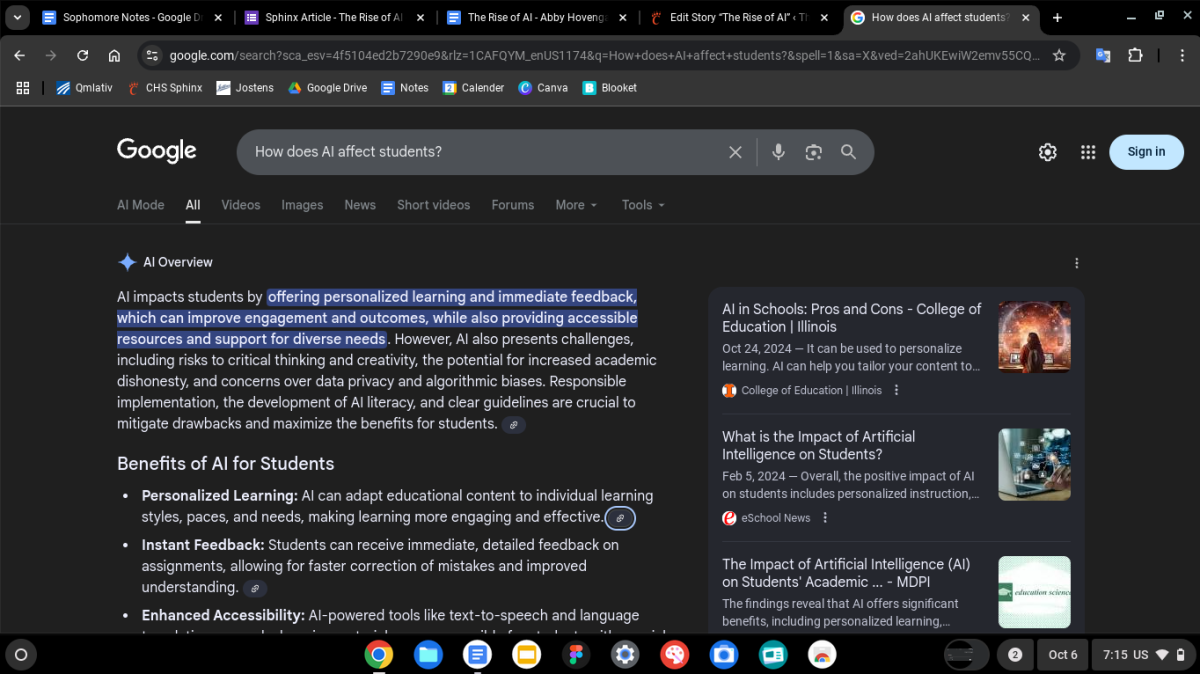
After years of AI evolving, it can now generate photos and videos, give you an overview of a topic so you don’t have to do your own research, and so much more. “I use it to help me write my music, it helps me get a visual on something if needed, and I use it to look up stuff if I need to” junior Jadelyn Firebaugh said.
This quick and easy way of life isn’t always a good thing, though. It’s gotten so easy for students to type in something like “Write a 400 word essay about Greek gods for my English assignment,” and have AI generate an entire essay for that student just so they don’t have to do their work or be creative with their writing. This makes many people, especially parents, teachers and students who claim they rarely use AI concerned that artificial intelligence may be making the newer generations less intelligent. CHS junior Izzie Bailey said, “I feel it could be useful, but overall, it’s evolving in the wrong direction. We should be using it to assist us rarely and for difficult scenarios, not things like an essay or to generate “art.” It would be useful for complex calculations, but I feel the way the public uses it is a waste.”
Luckily, multiple students at CHS have admitted to only using artificial intelligence for things like spell check and inspiration instead of using it for things like cheating on homework, writing essays for them, ect. One of these students being sophomore Maggie Mandell who said, “I think using AI to write essays is useless because we need to be able to write for ourselves.”
One thing almost everyone can agree on is that there are both positive and negative sides to the uses of AI, but as long as we be mindful, try to stay creative and only use it as a last resort, maybe AI isn’t such a bad thing.