



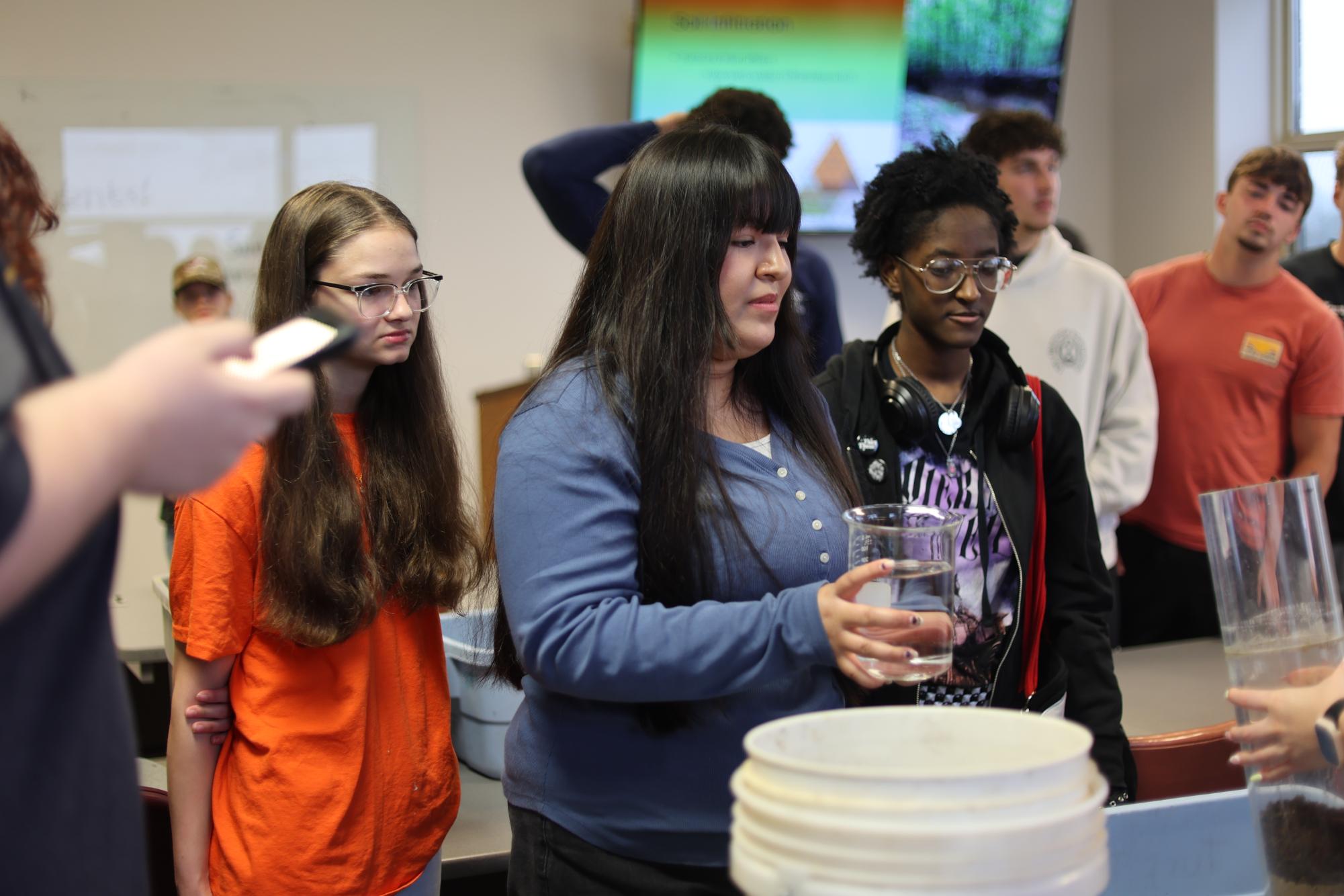
Every year in earth space science, there is a field trip to SIU where students learn new things about how fast water moves through each soil and what soil is located in most fields. There is also a simulation where you pour water right onto the soil and lift the thing it is in to see which one is fastest and which one has the most water coming out of it in the end. It turns out that peat soil has water run through it faster and lets out the most water. Junior Nevaeh Taylor said, “The best part about the whole trip was the water moving through different soils and seeing which one water actually moves through quicker and just being able to see how it happens.”
Students also learned about the differences between saltwater and freshwater fish, how some fish look like they have scales when really they do not, and how big some fish can get. They were even taught why some fish have different expressions on their faces. One fish they learned about was the alligator gar. An alligator gar is a fish that can get over eight feet long and has two long rows of sharp teeth to help it eat. Another fun fact they learned is that there are more saltwater fish than freshwater fish. Junior Mikayla Oetjen said, “I really enjoyed learning and seeing all the different kinds of fish and where they came from. I even saw a large mouth fish that I have never seen before.”
While everyone was eating lunch, the SIU students talked about where they came from, why they chose the school they did, what they chose to study and why they picked that specific thing to study. One student spoke about how she came to SIU from the Chicago area to learn about nature and soil. She explained that one of her high school teachers had mentioned the school to her, and it had everything she wanted to study and major in. Another student explained how they went to college because they really wanted to become a nurse, and how many different class options they had.
They also had the chance to learn about water line systems, including how much work it takes to get even amounts of water to many different places, the different techniques there are, how it is done and which way is most effective. They explained how the different pipe sizes play a part in water distribution, and how some pipes need to be placed differently so that they can actually distribute all the water evenly, or to the best of their ability.
The students then completed an activity where they were given a model town and 3 cups of water. They then needed to try to design a water line system in order to move water into the three cups as evenly as possible. It took many tries and lots of thinking. Junior Joselyn Navarro said, “My favorite part about the field trip would be the water line system because I got to learn how engineers get to build the different plumbing systems and how long it actually takes to get it right.”
